Evidence before guesses
Source calls, resolver links, known runtime behavior, and inference stay distinct. Incomplete results keep visible diagnostics.
Junet.store shares practical AI, MQL5, and open-source engineering — starting with MQL5 CodeGraph, a local analysis tool for evidence-backed architecture, impact, and context tracing.
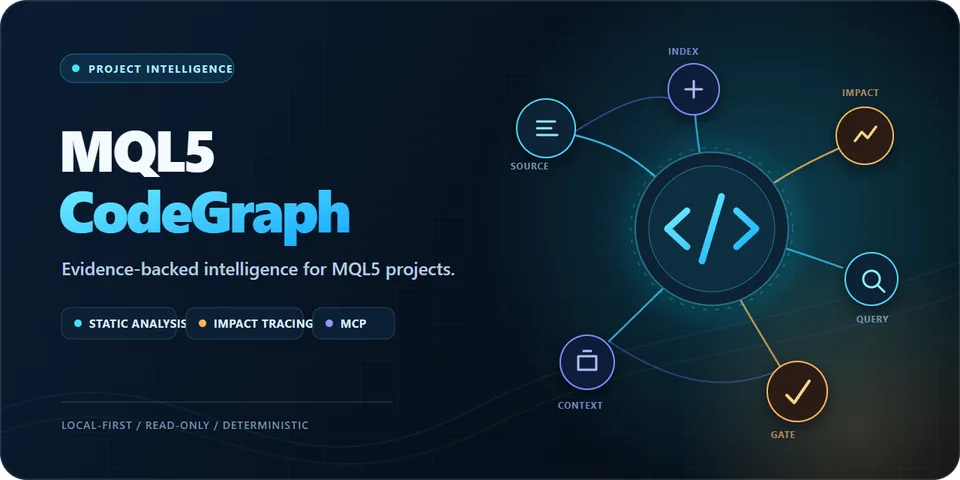
Source calls, resolver links, known runtime behavior, and inference stay distinct. Incomplete results keep visible diagnostics.
The core analyzer, CLI, loopback dashboard, and local MCP runtime need no cloud account or model key.
MIT source, open design discussions, reproducible bug reports, and visible contributor recognition.
Evidence-backed static code-graph intelligence for MQL5 repositories — local, deterministic, and usable from a CLI, dashboard, or AI agent.
MQL5 CodeGraph reads .mq5 and .mqh files in an operator-trusted repository, extracts structure and relationships, and produces a queryable JSON snapshot. Evidence origins stay explicit so an agent cannot quietly promote inference into fact.
Extract includes, classes, structs, enums, functions, methods, event handlers, and calls.
Query symbols, context, impact, directed paths, and GraphML exports.
Use a loopback dashboard for search, graph navigation, and source evidence.
Install the public v0.3.0 wheel, then select a trusted local MQL5 repository to analyze.
python -m pip install "mql5-codegraph[reference,mcp] @ https://github.com/junet03/mql5-codegraph/releases/download/v0.3.0/mql5_codegraph-0.3.0-py3-none-any.whl"The core analyzer needs no model API key. Python 3.11+ is required.
Five foundation articles, fully written in Vietnamese and English.
A practical workflow that starts from an entry point, gathers bounded context, checks blast radius, and separates static evidence from compiler and runtime truth.
AI can read many lines of code and still lose its bearings. A code graph connects symbols, calls, and event handlers to explicit evidence.
Understand the local MCP boundary, register mql5-codegraph-mcp per client, select a separate trusted project root, and maintain honest RAM-only snapshots.